
Notice: Undefined variable: PATH_INFO in /home/mediakno/public_html/as_alevel/Advertising/advertising.php on line 89
Mediaknowall Advanced > Regulation of Advertising | Home/Blog | Search Site |


Regulation of Advertising
Ever since Vance Packard's report, The Hidden Persuaders, appeared in 1957 there has been a lot of anxiety about the effects of advertising. Like violence, advertising is supposed to have a particular effect on the minds of younger and less educated audiences. Ads can transcend the medium in which they first appear by inviting all kinds of comment and headlines - as well as earning themselves a place in history.
The Most Controversial Ads in Fashion History - Debonair Magazine (December 12, 2007)
Legal, Decent, Honest And Truthful
In order to monitor and control advertising a number of different regulatory bodies have been established. Many countries have an Advertising Standards Authority, whose job it is to listen to complaints from the public, and establish whether or not a particular ad or campaign should be withdrawn. In the UK the situation is complex, as each medium is governed by a different regulatory body:
- Non-Broadcast Advertising is dealt with by the Advertising Standards Authority
- UK TV Advertising complaints are referred to the OfCom
- All advertising in the UK is subject to the Committee of Advertising Practice's Code (known as the CAP Code) and also to the Code of the European Advertising Standards Alliance.
All this leads to a maze of voluntary rules and legislation which must be negotiated by an agency seeking to produce a campaign. There are extremely strict rules regarding the advertising of tobacco (banned), alcohol (going that way), medicines/medical services and products aimed specifically at children. Advertising law is a complex area.
Regulation of Advertising in Hong Kong
Hong Kong is regarded as a main centre for advertising in Asia, and agencies here are increasingly offering their services in China. The Hong Kong government is therefore anxious to promote the advertising industry as ethical, and offering value for money.
The regulatory bodies screen TV ads before they are submitted for broadcast, but print advertising largely goes through unscreened. The ASA rely heavily on complaints to spur them to take action against an individual ad, whilst the ITC are more pre-emptive. The problem with this system is obvious: the ASA only acts AFTER an ad has appeared, and AFTER a certain number of people have complained about it. Therefore, by the time they rule that an advertisement is offensive, or untruthful, the campaign may well be over and the ads long gone. Also, an ad is an ad, and costs money to place in a newspaper. However, news stories about that ad are free, and will bring a brand to public notice. It is felt by many that advertising agencies are increasingly willing to push the boundaries of the code in order to grab audience attention through shock values.
You can find the Generic Code of Practice on Television Advertising Standards here.
Benetton
Several companies have long acknowledged this, and have deliberately used controversial campaigns. Benetton are perhaps the best known. Olivierio Toscani, the mastermind behind the decade-long strategy, claims that their ads bring humanitarian issues to the world's attention as well as selling clothing. Luciano Benetton says he is "only interested in the world and people...if I can make people more aware than that is all I offer". However, the storm of protest (and subsequent boycott of Benetton clothing by major US retailers) arising from the 2000 Death Row campaign was too much for the clothing manufacturer to cope with, and Toscani left the company. What do you think?
- Salon.com profile of Toscani
- Criticism of the Campaign - scroll down the page
Advertising Sex
—Mark Golin, Brandweek Online, March 6 2000
It is a truth universally acknowledged that Sex Sells. Ad agencies have been utilising this principle for as long as they have been advertising, successfully persuading the consumer that sexual attractiveness is a benefit of a plethora of products and services, from the obvious (lipstick) to the surreal (washing powder). Boy, do they earn those awards! Maslow doesn't really cover it, but the need to be sexually desirable does appear to be paramount in the world of women's magazines and certain zones of TV advertising. The big question is, however, how much sex sells, and how much offends and therefore alienates the consumer? Advertising Standards Authorities, censors and, more importantly, big distributors (such as Wal-Mart in the US) keep a supposedly tight rein on how much advertising may utilise sex, but there are increasing doubts about their effectiveness. As with violence, continued exposure to sexual imagery desensitizes, and advertisers seek to gain attention for their products by providing imagery that is continually more explicit. And, inevitably, the very explicitness of these ads generates a great deal of free publicity.
- Adweek Roundtable Discussion on Sex in Advertising - particularly print advertising and the role of magazine editors
American Apparel's Controversial Advertising
American Apparel make t-shirts, underwear, leggings, socks, hats and scarves in brightly coloured cotton. Nothing offensive there. However, since its inception, the company seems to have embraced the adage that "sex sells" rather too wholeheartedly. The original claim was that their advertising used employees to model the clothing, and that the ads — in contrast to the polished campaigns of rivals — were raw, cheeky, fresh, un-PhotoShopped, representing how the clothes looked in real situations (often involving a rumpled bed) as opposed to a carefully lit studio. However, this morphed into a deliberate policy of courting controversy through advertising, whether it involves using porn star Sasha Grey as a model (with - gasp! - her pubic hair showing), or using unauthorized images from Annie Hall or showing underage models in a variety of sexually suggestive positions, often wearing only one item from the company's clothing range (e.g. socks) at a time.

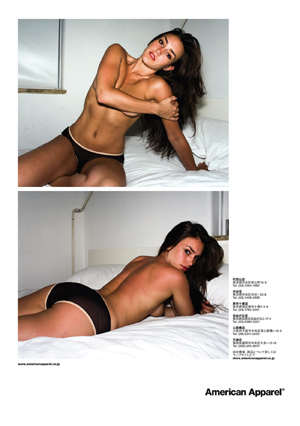
Like Benetton, American Apparel uses advertising to generate headlines, hoping that sales will benefit from the outraged blog inches. Every time they push a boundary, there are howls of protest. However, the company is in financial trouble - possibly because the overt sexuality of the advertising campaigns seems to be part of a wider, very unsavoury corporate culture that exploits employees. The founder, Dov Charney, has faced several sexual harassment suits from former female employees. Terry Richardson, the photographer used by many of the campaigns, has also been named and shamed as a man who uses his position of power to sexually exploit young models.
- Timeline of American Apparel Controversy - from The Week
- American Apparel Accused of Promoting Rape
- An American Dilemma - Oregon Daily Emerald
- A Rhetoric of Contradiction: Moral Agency, Neoliberalism and American Apparel
- American Apparel Now Sponsoring Bloggers and Porn Stars - Jezebel.com, January 20, 2009